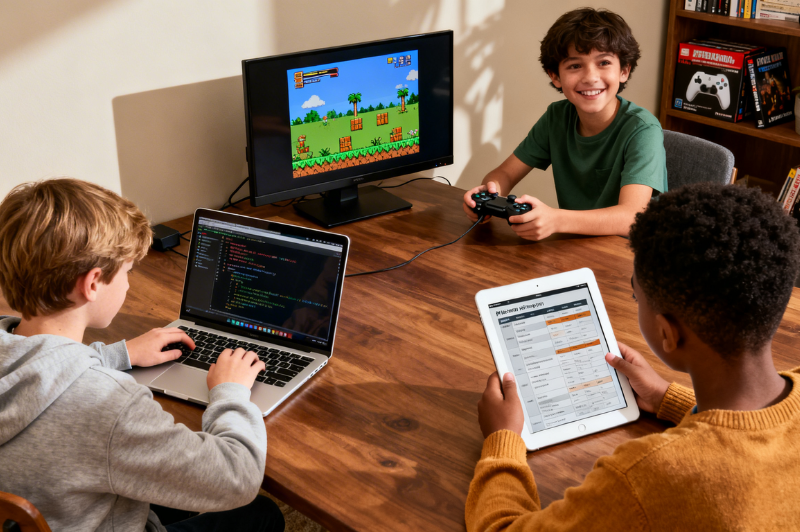
In 2D platformer games, the player moves across gaps, ledges, and obstacles through jumping, climbing, and careful positioning. A platform game is built around traversal. The route itself becomes the challenge. Britannica defines the genre through movement from platform to platform, with jumping, climbing, and swinging used to reach a destination. Wider genre references describe uneven terrain and suspended platforms as core features as well.
Platform types matter because they change how the player reads the level. A flat ledge asks for a clean jump. A moving ledge asks for timing. A slippery ledge changes stopping distance. A disappearing ledge tests pattern recognition. The platform is never just a place to stand. In platformer games, it becomes part of the ruleset that controls risk, rhythm, and movement.
Why Platformer Games Use Different Platform Types
A level built from the same surface from start to finish would feel flat very quickly. Designers vary platform behaviour to control difficulty, pace, and attention. Research on 2D platformer level design treats movement challenge as a genre-specific problem, where jump difficulty, surface behaviour, and obstacle placement work together rather than separately.
Different platform types teach different lessons. A moving platform teaches patience and rhythm. A breakaway platform punishes hesitation. A conveyor platform interferes with control, which forces the player to adjust direction mid-movement. Platform variation keeps the player alert because the level keeps asking a new question. Can you wait, react, recover, or commit? Mechanical variety gives a platformer game much of its identity.
10 Common Platform Types in Platform Video Games
Standard Platforms
Standard platforms are fixed surfaces with no special behaviour. Designers use them to teach the player how far a jump carries, how long airtime lasts, and how much space a safe landing needs. They give the player a stable landing point and create the baseline movement rules for the rest of the level. In a platform game, they usually appear first because they let the player learn jump distance, landing space, and character momentum without extra interference.
Jump-Through Platforms
Jump-through platforms can be crossed from below and landed on from above. They remove the need for ladders or rigid stair-step routes, which keeps upward movement fast and readable. They support vertical movement without boxing the player into a rigid path. Many side-scrolling games use them to keep movement readable, since the player can rise through a layer, land, then continue upward or drop down later. This type appears constantly in 2D platformer games because it keeps vertical routes clean and flexible.
Falling Platforms
Falling platforms stay in place until the player lands, then drop after a short delay. Their warning window is usually brief, which means the player must read the next landing point before touching down. The purpose is pressure and urgency. The player cannot wait long to decide the next move. This type creates urgency without changing the basic controls, which makes it a reliable way to raise tension in platformer games without adding a new button or mechanic.
Sticky Platforms
Sticky platforms change traction in the opposite direction from ice or slick ground. They can make a character stop quickly, cling longer, or hold to unusual routes across a level. Some sticky surfaces hold the character in place more firmly. Others support movement on walls or ceilings. Technical discussions of 2D platform surface dynamics describe sticky ground as a surface with high deceleration and reduced sliding, which changes how quickly the character stops or turns. In design terms, sticky platforms make movement feel heavy, deliberate, or unusual.
Slippery Platforms
Slippery platforms reduce traction. Ice stages in many platformers rely on this effect because the player keeps moving farther than expected after input stops. The player slides farther, stops later, and needs more care before each jump. Surface-dynamics writing on 2D platform design describes slippery ground as low-friction terrain that extends movement after the player releases input. For players, the effect is simple. Precision becomes harder, and every landing needs more control.
Moving Platforms
Moving platforms shift horizontally, vertically, or along a set pattern. Some act like elevators, and others loop through the same route, which lets the player learn timing through repetition. They turn a simple jump into a timing problem. A recent study of movement in 2D platformers identifies elevator platforms and looping platforms as distinct moving forms used to alter navigation and pacing. Designers use them to train waiting, rhythm, and route planning without changing the player character itself.
Conveyor Platforms
Conveyor platforms push the player in a fixed direction. Their direction may help the player or sabotage the jump, depending on where the platform sends the character next. Some move gently and some drag the character toward a hazard or away from a jump line. The design effect is immediate because the player loses part of their normal control. The reference guide describes conveyor platforms as a way to alter platform behaviour and create a harder situation through predictable but hostile movement.
Break-Away Platforms
Break-away platforms crack, collapse, or vanish after contact. Visual cues such as cracks or sound can warn the player, though the safe window is still very short. They differ from falling platforms in a useful way. A falling platform drops as a whole object. A breakaway platform may disappear, crumble, or leave nothing behind. The player gets a brief chance to react, though retreat is usually gone once the surface gives way. In level design, this platform type pushes commitment. Every landing has a cost attached.
Disappearing Platforms
Disappearing platforms cycle in and out on a timer. They can create a visible rhythm in a level, which turns waiting into a skill rather than dead time. The player may need to wait, watch the pattern, then move during the short safe window. The reference guide treats disappearing and reappearing platforms as a danger pattern that can still leave a path to success when placed carefully. In play, they test timing and observation at the same time.
Trap or Collapsing Platforms
Trap or collapsing platforms are built to surprise the player. Some tilt under weight, and others break after a delayed reaction, which catches players who trust the surface very early. A surface may look safe, then tilt, break, or reveal danger under the character. The reference points to leaning and balanced platforms that react to weight and movement, creating timing puzzles that punish rushed positioning. This type usually appears later in a stage, once the level has already taught the player how normal ground behaves.
Which Platform Types Feel Easiest and Hardest for Beginners in 2D Platformer Games
Beginners usually understand standard platforms, jump-through platforms, and slow moving platforms more quickly, because these mechanics are easier to read in simple learning games and more accessible level design. These let a child read the result of a jump clearly and correct mistakes without hidden punishments. These types keep the core task readable. The player can focus on distance, timing, and landing without fighting hidden rules. Standard platforms teach the movement base. Jump-through platforms make vertical routes easier to read. Slow-moving platforms add timing without demanding instant reactions.
Harder platform types usually interfere with control or reduce decision time. Slippery platforms change the stopping distance. Falling and breakaway platforms punish hesitation. Disappearing platforms require pattern reading before movement even begins. Trap platforms are harder for a different reason. They ask the player to distrust the floor. For a child or beginner, that jump in challenge can feel sharp if it appears before the basic movement rules feel familiar. Research on platformer level analysis treats single-jump difficulty and completion probability as central design questions, which fits this beginner progression well.
How Kids Can Start Reading Platformer Games Like a Designer
Notice what changed when a jump felt harder
A child does not need to build a full game before spotting design patterns. Careful attention during play can already reveal why a level feels fair, tense, or difficult. Ask a simple question in the moment. What changed before that jump felt harder. The answer may be surface grip, platform speed, landing space, or a hazard near the edge. This habit helps children move from simply playing a level to reading how a platformer game was built.
Compare two platforms in the same level
Comparison is another useful step. Ask your child to look at two platforms in the same section. Which platform gives more thinking time. Which platform demands a faster move. Which surface changes the stopping distance. This builds early design awareness because the child begins linking platform behaviour with player response. Children who already enjoy spotting these movement patterns in 2D platformer games may be ready to build a simple scratch game, where they can test jumps, level layout, and basic mechanics on their own.
Conclusion
Platform types give children a practical way to read game design instead of just reacting to it. A useful next step is to pick any level and ask three questions during play: which platform changed movement, which platform changed timing, and which platform raised the risk. This habit turns casual play into design thinking. Once a child can spot standard, moving, slippery, and disappearing platforms, a platform game starts to make more sense from the inside.
Children who enjoy spotting level patterns may do well in guided coding classes where they build their own stages and experiment with mechanics. BrightCHAMPS offers live coding courses for kids that can channel interest in platformer games, 2D platformer games, and platformer game design into real project-based practice.
FAQs
Q1. What is a platform game?
A platform game is a video game built around movement between platforms. Players jump, climb, avoid hazards, and reach an objective through timing, control, and careful positioning during play sessions.
Q2. Which platform type is easiest for beginners?
Standard platforms are usually easiest for beginners because movement remains predictable. Jump-through platforms can work early as well, since they support recovery from missed jumps and cleaner level flow overall.Q3. Why do 2D platformer games use moving and disappearing platforms?
Moving and disappearing platforms change timing. They force players to read patterns, judge distance, and commit to jumps at the right moment instead of relying on flat movement for progress.Q4. How can kids study platformer games like designers?
Kids can watch how a level changes movement. Surface grip, platform speed, spacing, and hazards reveal what the designer wants the player to learn or practise during each section clearly.PakarPBN
A Private Blog Network (PBN) is a collection of websites that are controlled by a single individual or organization and used primarily to build backlinks to a “money site” in order to influence its ranking in search engines such as Google. The core idea behind a PBN is based on the importance of backlinks in Google’s ranking algorithm. Since Google views backlinks as signals of authority and trust, some website owners attempt to artificially create these signals through a controlled network of sites. In a typical PBN setup, the owner acquires expired or aged domains that already have existing authority, backlinks, and history. These domains are rebuilt with new content and hosted separately, often using different IP addresses, hosting providers, themes, and ownership details to make them appear unrelated. Within the content published on these sites, links are strategically placed that point to the main website the owner wants to rank higher. By doing this, the owner attempts to pass link equity (also known as “link juice”) from the PBN sites to the target website. The purpose of a PBN is to give the impression that the target website is naturally earning links from multiple independent sources. If done effectively, this can temporarily improve keyword rankings, increase organic visibility, and drive more traffic from search results.
Jasa Backlink
Download Anime Batch