- Traditional
- GCBD883
- by Hopmaniak
- Location:
- Noord-Brabant, Netherlands
- N 51° 33.216′ E 005° 11.411′
What would you do if Papa Smurf trusted you with protecting a legendary stash of rare Blue Smurf hops? Hopmaniak – In Search of the Smurfs… (GCBD883) sends geocachers deep into Smurf territory on a playful mission filled with clever storytelling, hidden mechanisms, and a delightful final reveal.
Tucked among the fields of Noord-Brabant, the cache appears to be little more than a sturdy gray box marked with an unmistakable Smurf™ face. But seasoned geocachers quickly realize this is no ordinary container. The cache invites players to slow down, observe carefully, and think like a Smurf.
Tucked among the fields of Noord-Brabant, the cache appears to be little more than a sturdy gray box marked with an unmistakable Smurf™ face. But seasoned geocachers quickly realize this is no ordinary container. The cache invites players to slow down, observe carefully, and think like a Smurf.
The story behind the cache sets the tone perfectly. A wild-eyed brewer known only as the Hopmaniac has become obsessed with creating the ultimate IPA beer, hunting rare hop varieties across the countryside. When he catches wind of Papa Smurf’s secret, Blue Smurf hops, chaos follows. To keep the precious harvest safe, the Smurfs hide it away in a secret location, along with the log sheet itself.
That blend of humor and imagination carries seamlessly into the physical cache experience. Rather than relying on difficult terrain or complicated puzzles, the cache focuses on interaction and surprise. Geocachers are rewarded for paying attention to the details right in front of them, and the mechanism creates one of those satisfying “aha!” moments that make gadget-style caches so memorable.
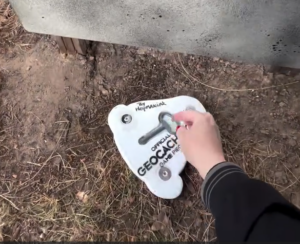
The secret to opening this cache lies in using your head. After inspecting the Smurf head more carefully, seekers realize it can be turned and moved. As the head slides downward, it suddenly drops free, revealing a hidden key on the opposite side. That key unlocks the real magic of the cache.
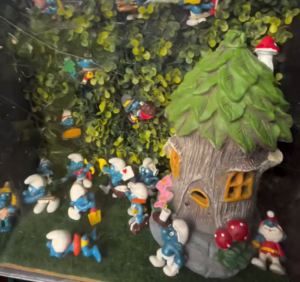
Once the cache is opened, the plain exterior gives way to a fully realized miniature Smurf world hidden inside. Tiny decorative details transform the container into a scene straight out of a storybook, rewarding curious geocachers with an experience that feels whimsical, handcrafted, and deeply personal. Even the inside of the cache door continues the narrative, featuring a humorous “wanted” poster connected to the stolen Blue Smurf hops.

What makes this cache especially charming is how cohesive the entire experience feels. The story, mechanism, visual design, and the final reveal all support one another without overcomplicating the hunt. It’s approachable enough for a wide range of geocachers while still delivering the kind of creative payoff that leaves a lasting impression.
The cache owner, hopmaniak, also reminds visitors to carefully replace everything exactly as found so Papa Smurf stays happy and the adventure remains intact for the next seekers.
So keep your senses sharp, watch out for wandering Hopmaniacs, and remember: the Smurfs may be counting on you.
Header image by geosanity68.
Continue to explore some of the most amazing geocaches around the world. Check out all of the Geocaches of the Week on the Geocaching blog. If you would like to nominate a Geocache of the Week, fill out this form.
PakarPBN
A Private Blog Network (PBN) is a collection of websites that are controlled by a single individual or organization and used primarily to build backlinks to a “money site” in order to influence its ranking in search engines such as Google. The core idea behind a PBN is based on the importance of backlinks in Google’s ranking algorithm. Since Google views backlinks as signals of authority and trust, some website owners attempt to artificially create these signals through a controlled network of sites.
In a typical PBN setup, the owner acquires expired or aged domains that already have existing authority, backlinks, and history. These domains are rebuilt with new content and hosted separately, often using different IP addresses, hosting providers, themes, and ownership details to make them appear unrelated. Within the content published on these sites, links are strategically placed that point to the main website the owner wants to rank higher. By doing this, the owner attempts to pass link equity (also known as “link juice”) from the PBN sites to the target website.
The purpose of a PBN is to give the impression that the target website is naturally earning links from multiple independent sources. If done effectively, this can temporarily improve keyword rankings, increase organic visibility, and drive more traffic from search results.